
Views: 25 Author: Site Editor Publish Time: 2026-09-19 Origin: Site
The aluminium extrusion process is a manufacturing method in which a heated aluminum billet is forced through a specially designed die to create profiles with a consistent cross-sectional shape. This process enables manufacturers to produce lightweight, strong, and highly customizable aluminum components for industries such as construction, transportation, electronics, renewable energy, and industrial equipment.
Compared with machining or casting, aluminium extrusion offers greater design flexibility, excellent material utilization, and cost-effective production for both standard and custom profiles.
This guide explains every stage of the aluminium extrusion process, from billet preparation to finishing, while highlighting the equipment involved, common quality considerations, and best practices for protecting aluminum profiles throughout production.
Extrusion is a metal forming process that reshapes aluminum by applying high pressure rather than removing material.
The process begins with a cylindrical aluminum billet, which is heated until it becomes soft enough for forming. A hydraulic extrusion press then forces the billet through a precision-engineered die. As the aluminum exits the die opening, it takes on the exact profile shape defined by the die.
Because aluminum has excellent formability and a favorable strength-to-weight ratio, extrusion can produce everything from simple bars and tubes to highly complex structural profiles with tight dimensional tolerances.
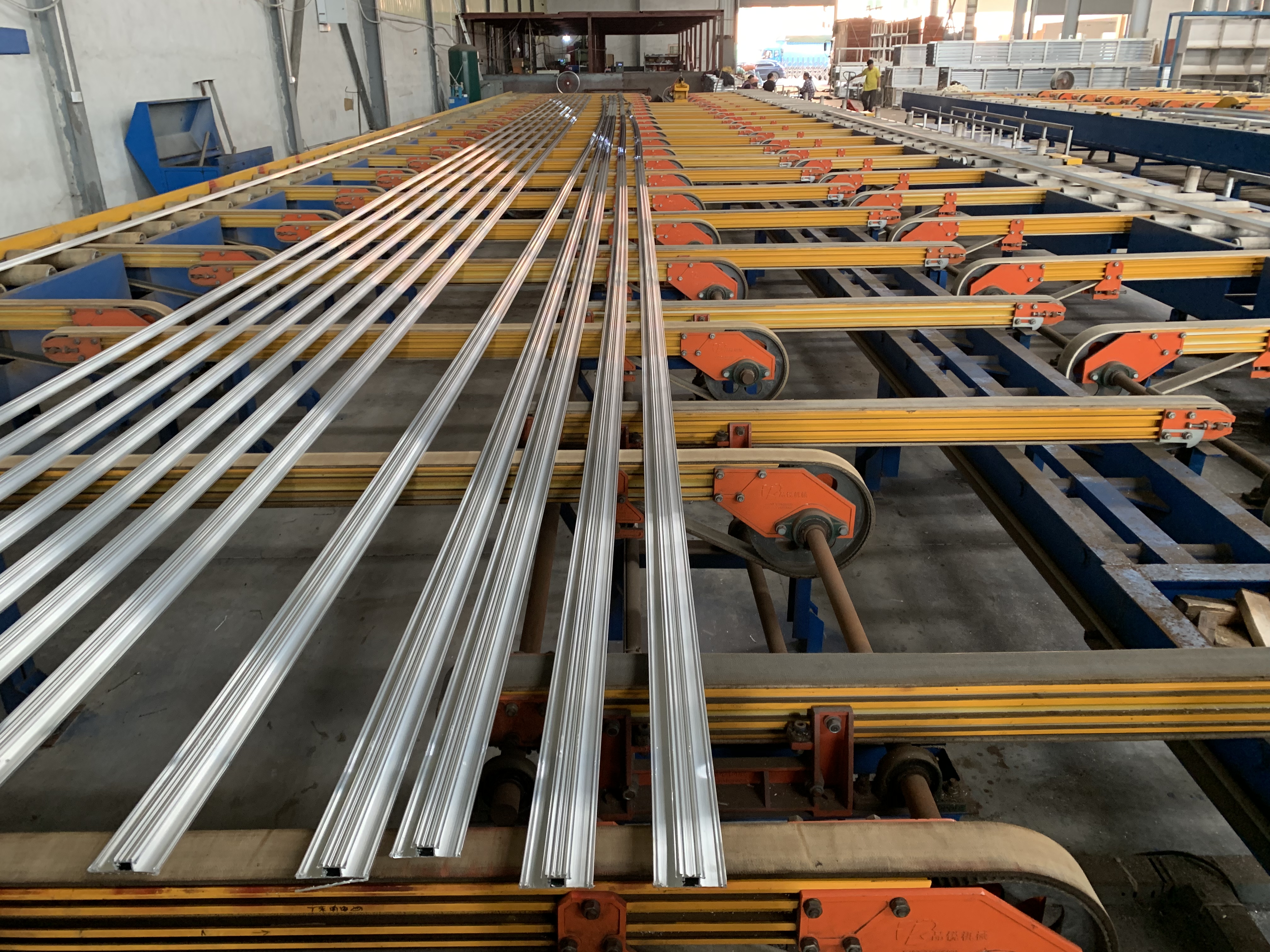
Aluminium extrusion has become one of the most important manufacturing processes because it combines efficiency with exceptional design flexibility.
Its key advantages include:
Producing complex cross-sectional shapes in a single operation
Maintaining excellent dimensional accuracy
Reducing material waste compared with machining
Supporting both high-volume and customized production
Delivering lightweight components with excellent mechanical performance
Allowing a wide range of surface finishing options
These advantages make extruded aluminum suitable for industries ranging from architectural systems to automotive manufacturing and industrial automation.
Although extrusion lines may vary depending on the manufacturer and product requirements, the overall production sequence follows a similar workflow.
Everything begins with an aluminum billet.
A billet is a solid cylindrical piece of aluminum alloy that serves as the raw material for extrusion. Billets are available in different diameters and alloy grades depending on the final product requirements.
Before extrusion, manufacturers select the appropriate alloy based on factors such as:
Strength requirements
Corrosion resistance
Surface finish expectations
Extrudability
End-use application
Common extrusion alloys include the 6000 series, particularly 6063 and 6061, due to their excellent balance of strength, corrosion resistance, and formability.
The billet is heated in a furnace before entering the extrusion press.
Heating softens the aluminum sufficiently for plastic deformation while maintaining its solid state. Unlike melting, extrusion relies on carefully controlled temperatures that allow the metal to flow under pressure without becoming liquid.
Temperature control is one of the most critical factors during this stage.
Proper billet heating helps:
Improve metal flow
Reduce extrusion force
Minimize die wear
Improve surface quality
Maintain consistent dimensions
Insufficient heating increases resistance during extrusion, while excessive temperatures may negatively affect profile quality.
While the billet is heating, the extrusion die is also prepared.
The die determines the final cross-sectional shape of the aluminum profile. Every opening, cavity, corner, and wall thickness is precisely engineered before production begins.
Dies are typically manufactured from high-strength tool steel capable of withstanding repeated exposure to extreme pressure and temperature.
Before installation, the die is often preheated to reduce thermal shock and improve metal flow during extrusion.
The quality of the die has a direct impact on:
Profile dimensions
Surface finish
Production consistency
Extrusion efficiency
This is the core stage of the aluminium extrusion process.
The heated billet is transferred into the extrusion press container, where a hydraulic ram applies enormous pressure to force the aluminum through the die opening.
As the material exits the die, it forms a continuous profile that precisely matches the die geometry.
Several factors must remain carefully controlled during extrusion, including:
Ram speed
Extrusion pressure
Billet temperature
Die temperature
Alloy characteristics
Proper process control helps achieve smooth surfaces, consistent dimensions, and stable production.
Immediately after leaving the die, the aluminum profile is at its most vulnerable.
Although it has already formed its final shape, the profile is still extremely hot and relatively soft. Even minor contact with hard surfaces can cause scratches, dents, deformation, or surface contamination.
This stage is one of the most critical for maintaining product quality.
To protect the newly extruded profiles, manufacturers typically use specialized handling systems equipped with heat-resistant felt belts, felt rollers, and protective pads. These materials provide a soft contact surface that minimizes friction while withstanding the elevated temperatures of freshly extruded aluminum.
Effective profile handling at the die exit helps:
Reduce surface scratches
Prevent deformation
Maintain cosmetic appearance
Improve product consistency
Reduce scrap and rework
For manufacturers producing architectural or decorative aluminum profiles, protecting the surface during this stage is just as important as the extrusion process itself.

After leaving the die, the profile must be cooled in a controlled manner.
Cooling allows the aluminum to gradually gain sufficient strength for downstream handling while helping preserve its dimensional accuracy.
Depending on the alloy, profile geometry, and production requirements, cooling may involve:
Ambient air cooling
Forced-air cooling
Water mist or spray systems (for selected applications)
The cooling rate influences the mechanical properties of the finished profile, making process control essential.
Proper cooling contributes to:
Improved dimensional stability
Better mechanical performance
Reduced internal stresses
More consistent product quality
Even with careful process control, aluminum profiles may experience slight distortion or internal stress after cooling.
To correct these issues, profiles are transferred to a stretching machine.
During stretching, a controlled tensile force is applied to:
Straighten the profile
Remove residual stresses
Improve dimensional accuracy
Prepare the material for cutting and finishing
This step is particularly important for applications requiring precise tolerances, such as industrial equipment, curtain wall systems, and precision structural components.
Once the profile has been straightened, it is cut into the required lengths according to customer specifications or downstream processing requirements.
Precision cutting ensures:
Consistent product dimensions
Efficient packaging and transportation
Compatibility with secondary fabrication processes such as machining, drilling, or assembly
Depending on the production line, cutting may be performed using automated flying saws or stationary saw systems designed for high-speed, high-accuracy operation.
For many aluminum alloys, particularly the widely used 6000 series, extrusion is followed by an aging process to achieve the desired mechanical properties.
During aging, the profiles are placed in temperature-controlled ovens for a specified period. This controlled heat treatment strengthens the material through precipitation hardening, improving its overall performance.
Proper aging helps enhance:
Tensile strength
Hardness
Structural stability
Long-term durability
The exact aging conditions vary depending on the alloy grade and the required mechanical properties.
After heat treatment, aluminum profiles may undergo various finishing processes depending on their intended application.
Common surface treatments include:
Anodizing
Powder coating
Electrophoretic coating
Wood grain transfer
Mechanical polishing
Brushing
These treatments improve corrosion resistance, appearance, and durability.
Before shipment, manufacturers also conduct quality inspections to verify:
Profile dimensions
Straightness
Surface quality
Mechanical properties
Coating performance (if applicable)
A comprehensive inspection process helps ensure that finished profiles meet customer specifications and industry standards.
An efficient extrusion line depends on more than just an extrusion press. Multiple pieces of equipment work together to ensure consistent production and high-quality profiles.
Typical aluminium extrusion equipment includes:
Billet storage and handling systems
Billet heating furnace
Extrusion press
Extrusion die
Die oven
Run-out table
Cooling system
Puller system
Stretching machine
Precision saw
Aging oven
Surface treatment equipment
Quality inspection instruments
Each piece of equipment contributes to the overall efficiency, dimensional accuracy, and surface quality of the final product.
Although modern extrusion technology is highly advanced, quality issues can still occur if process parameters are not properly controlled.
Some of the most common challenges include:
Freshly extruded aluminum is soft and easily damaged during conveying or handling.
Possible causes include:
Contact with hard surfaces
Worn conveyor materials
Improper profile transfer
Contamination on production equipment
Profiles may bend, twist, or warp due to:
Uneven cooling
Improper stretching
Incorrect handling during transportation
Inconsistent dimensions may result from:
Die wear
Incorrect billet temperature
Unstable extrusion speed
Poor process control
Common surface defects include:
Die lines
Drag marks
Oxidation
Surface contamination
Many of these issues can be minimized through proper equipment maintenance, optimized process parameters, and careful material handling.
Many people assume that once aluminum leaves the extrusion die, the manufacturing process is essentially complete. In reality, some of the most critical quality risks occur immediately after extrusion.
Freshly extruded profiles are:
Extremely hot
Relatively soft
Susceptible to scratching
Easily deformed by excessive pressure
Sensitive to contamination
Even if the extrusion process itself is well controlled, improper handling can reduce product quality and increase scrap rates.
This is why profile protection has become an essential part of modern aluminium extrusion production.
Heat-resistant felt products play an important role in protecting aluminum profiles throughout the conveying and handling stages.
Unlike conventional conveyor materials, industrial felt provides a soft, heat-resistant contact surface that minimizes friction while maintaining reliable performance in high-temperature environments.
Depending on the stage of production, different heat-resistant fibers are selected to match the operating temperature:
PBO felt – Suitable for the highest-temperature sections immediately after the die exit.
Kevlar felt – Commonly used where both heat resistance and abrasion resistance are required.
Nomex felt – Ideal for medium-temperature conveying applications.
Polyester felt – Typically used in lower-temperature sections toward the end of the production line.
These materials are manufactured into products such as:
Endless felt belts
Felt rollers
Felt pads
Spacer sleeves
Felt strips
When properly selected and maintained, heat-resistant felt solutions help:
Reduce surface scratches and dents
Protect decorative and architectural finishes
Improve conveying stability
Extend equipment service life
Reduce maintenance frequency
Minimize material waste and rework
For manufacturers producing high-quality aluminum profiles, profile protection is not simply an accessory—it is an integral part of maintaining consistent product quality.
The aluminium extrusion process is a manufacturing method that shapes heated aluminum by forcing it through a specially designed die to produce profiles with a consistent cross-sectional shape.
Heating softens the aluminum, allowing it to flow through the die under pressure while remaining in its solid state. Proper heating improves metal flow, reduces extrusion force, and contributes to better surface quality.
A complete extrusion line typically includes a billet furnace, extrusion press, dies, cooling system, run-out table, stretching machine, saw, aging oven, and quality inspection equipment.
Common defects include surface scratches, die lines, dimensional variations, twisting, warping, and profile deformation. Many of these issues can be reduced through proper process control and careful profile handling.
Freshly extruded aluminum profiles remain hot and relatively soft after leaving the die. Careful handling helps prevent scratches, deformation, and other surface defects that can affect product quality.
Heat-resistant felt materials—including PBO, Kevlar, Nomex, and Polyester—are widely used in belts, rollers, pads, and sleeves to protect aluminum profiles throughout different stages of the extrusion line.
The aluminium extrusion process is far more than simply forcing heated aluminum through a die. It is a carefully controlled manufacturing sequence in which every stage—from billet preparation and extrusion to cooling, stretching, aging, and final inspection—contributes to the quality of the finished profile.
Equally important is what happens after the aluminum exits the die. Proper handling and surface protection are essential for preserving profile quality, especially in applications where appearance, dimensional accuracy, and consistency are critical.
By combining well-controlled production processes with appropriate profile protection solutions, manufacturers can improve operational efficiency, reduce defects, and produce aluminum profiles that meet the demanding standards of today's construction, transportation, industrial, and architectural markets.
Looking for the right heat-resistant felt products for your aluminium extrusion process? Email us at toby@gdcalm.com to discuss your application and receive a tailored solution.